|
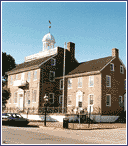
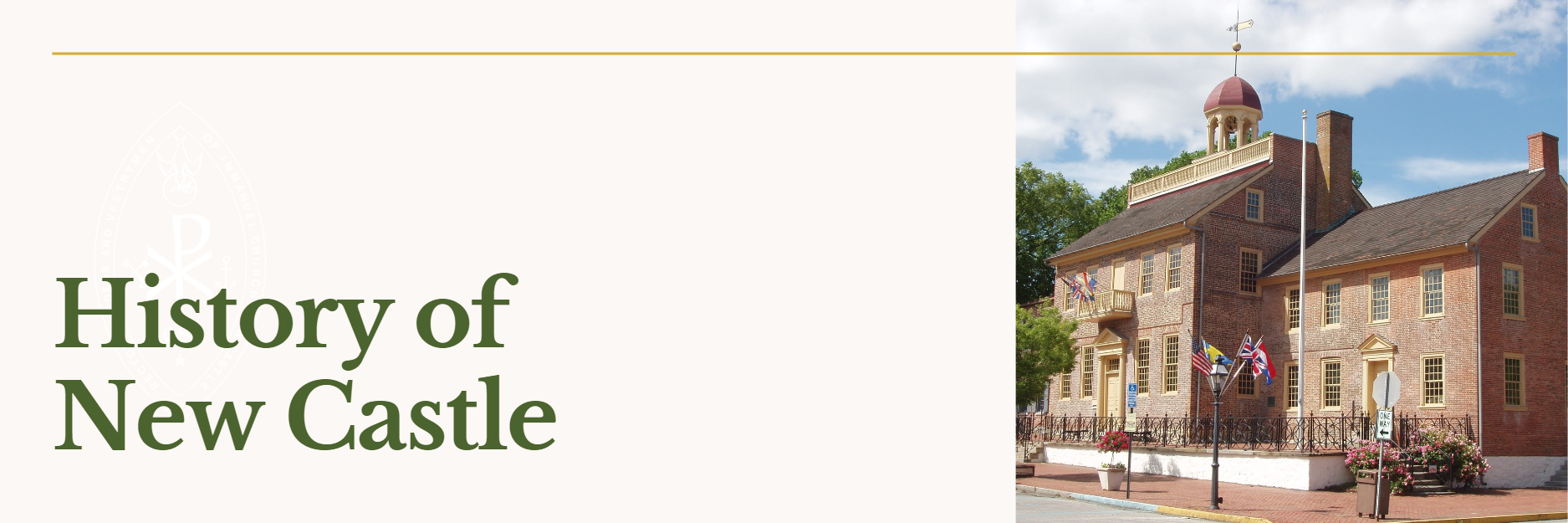
Immanuel Church on the Green is located in the heart of Old New Castle, a living village of well preserved colonial and federal homes and public buildings. A stroll through New Castle will reveal the original capital of Delaware, the site where William Penn landed in America, as well as beautiful 17th, 18th and 19th century buildings – all within a 7-block walk of the Delaware River.
The Swedes, the Dutch, and the English
The Swedes arrived and built a fort near what is now Wilmington, Delaware, just up the river from New Castle, in 1638. However, the Dutch, believing they had a prior claim to the land, asserted their claim to it by building Fort Casimir in New Castle in 1651. Dutch Governor Peter Stuyvesant headed the fort and used it to isolate the Swedish settlement. The Swedes retaliated by overtaking the fort and renaming it Fort Trinity. But in 1655, the Dutch regained the fort and once again changed the name of the settlement to New Amstel.
England took the land from the Dutch, and had a firm control of the settlement by 1674, renaming it New Castle.
From Pennsylvania to Delaware
In 1682 the Duke of York handed over a large piece of his American holdings to William Penn. This land included present-day Pennsylvania and Delaware. Penn first landed in America in 1682 and his first step on American soil took place in New Castle, from which he journeyed upriver to found Philadelphia.
But Penn's Quaker government was not favorably viewed by the Dutch, Swedish, and English settlers in Delaware, who almost immediately began petitioning for their own Assembly. They were finally successful in 1704, and New Castle became the capital of the colony. Called Separation Day, this event is celebrated in New Castle every year on the first Saturday in June.
 Revolutionary Times Revolutionary Times
As the colonial capital, New Castle grew in size and stature. Larger houses were constructed, and businesses sprang up to accommodate the judges, lawyers, and other professionals who had business in the capital. As the Revolution drew near, political debates and protests in the colony were centered in New Castle. Several signers of the Declaration of Independence lived in New Castle – one of them, George Read, is buried in the Immanuel cemetery.
Although Delaware was the first state to ratify the Constitution, in December of 1787, it did so in Dover, where the capital had been moved in 1777, rather than New Castle.
The Federal Period and Beyond
After the Revolution, New Castle prospered. Although it was no longer the capital of Delaware, it served as a destination on the first overland turnpike built from the Chesapeake River. Saving a 400-mile trip around the Delaware peninsula, the highway became a central trading route, bringing goods and passengers right to New Castle.
When this prosperity was threatened by the building of a canal to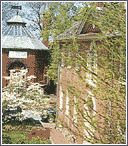 connect the Delaware and Chesapeake rivers, merchants and other businessmen constructed a railroad to cover the route. It opened in 1828, the same year as the canal. connect the Delaware and Chesapeake rivers, merchants and other businessmen constructed a railroad to cover the route. It opened in 1828, the same year as the canal.
But the small railroad wasn't enough to maintain New Castle's dominance. By 1840, train lines ran between Baltimore and Philadelphia, bypassing the much smaller and less significant city. By the end of the nineteenth century, the county seat was moved to the larger city of Wilmington and New Castle fell into an economic decline.
New Castle Today
Nineteenth-century New Castle's decline meant that many owners of homes could no longer afford to make changes to them, which is why so many buildings have been preserved, especially from the Federal period. When New Castle was "rediscovered" during the Colonial Revival craze in 1920s and 1930s, its buildings were largely unaltered, and remain so today.
Today, strolling the brick sidewalks of New Castle, listening to the church bells and taking in the large green at the center of town, it's possible to imagine what village life must have been like in early nineteenth-century America.
*Source for this history: The New Castle Heritage Trail brochure, published by the Mayor and Council of New Castle and the Historic New Castle Visitors Bureau.
|
 The Episcopal Church
Welcomes You
The Episcopal Church
Welcomes You



 Revolutionary Times
 connect the Delaware and Chesapeake rivers, merchants and other businessmen constructed a railroad to cover the route. It opened in 1828, the same year as the canal.