Dear Friends,
Welcome to Immanuel on the Green!

I hope that you are encouraged by what you see on our website and will plan on visiting Immanuel Church in the near future. We are sure to be enriched by your presence.
The Book of Common Prayer describes the mission of the Church in this way: "The mission of the Church is to restore all people to unity with God and each other in Christ... The Church pursues its mission as it prays and worships, proclaims the Gospel, and promotes justice, peace, and love... The Church carries out its mission through the ministry of all its members." (BCP 1979 p. 855)
Immanuel’s worship, Christian formation programs, Outreach projects, and fellowship opportunities help to equip the people of this parish for the mission we share. And from that place of strength and encouragement the people of Immanuel on the Green move to care for others in our community and beyond. Inviting new people into this parish family to share in our hopes, dreams and endeavors is a pleasure and delight. As a sign of our welcome, the church is open every day from 9 to 5 for prayer and meditation. We invite you to come and experience the prayerful atmosphere of our beautiful and serene church building which has been hallowed by the prayers of the faithful and the searching for over 300 years.
We are honored by your visit to this site. Please know that you are always welcome at Immanuel. No matter where you are on your spiritual journey, we invite you to consider this community of faith!
In Christ’s peace,
(Fr.) Chris Keene
Our History
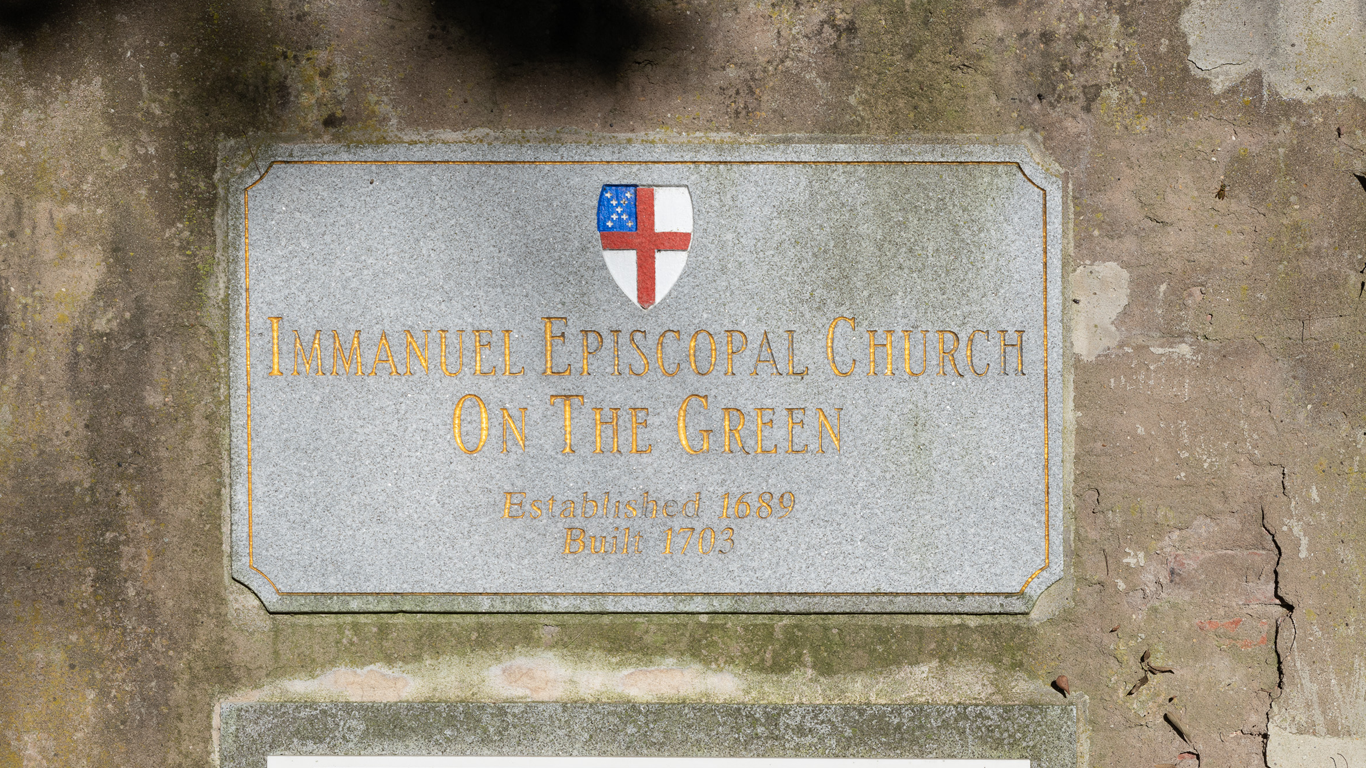
Founded in 1689, Immanuel Church in New Castle, Delaware is one of the oldest Episcopal parishes in the United States, and the oldest continuously operating Anglican/Episcopal parish in the country. Immanuel's parishoners have been worshipping on the spot where the church stands for over 325 years. Our history and that of the town of New Castle have always been closely linked, and continue to be so today.
 A Colonial Church
Immanuel Church was founded in 1689 and was the first parish of the Church of England in Delaware (then still part of Pennsylvania). Work on a church building began in 1703, and was mostly completed by 1708.
The Reverend George Ross was the first rector of Immanuel, arriving in 1705 as a missionary sent by the Society for the Propagation of the Gospel. Ross served as rector for Immanuel parish from 1705 until 1708 and then again from 1714 to 1754. Much as we do today, Ross offered two services on Sunday, and administered Holy Communion regularly. He also served in other churches in the area, and was willing to travel to meet the needs of the colonial population.
Anglicans were a minority in the colony, which had been heavily settled by Presbyterians, Anabaptists, and Quakers. Ross felt a keen sense of competition, and made it his life's work to bring as many people in the village to Anglicanism as possible. Although he often grumbled about the lack of dedicated attendance, Ross was successful in his goal, and left a flourishing church behind him.
Revolutionary Times and Beyond
The American Revolution was a difficult time for the Anglican Church in the colonies. As the official state church of England, it struggled to find a role once the United States and England were no longer considered one nation. The church continued to exist and became self-governing as the Protestant Episcopal Church in the United States of America otherwise known as the Episcopal Church after the Revolution.
During the later years of the 18th century, the church, known as the "Old Church", had fallen into disrepair to the point where it was dangerous to be inside. The rector at the time, Robert Clay, himself "loaned" the parish 1600 dollars to perform repairs on the church.
Despite declining membership, in 1820 the parish decided to invest heavily in improvements to the church building. William Strickland, a noted American architect of the early 19th century, directed these improvements at his own expense, which included the addition of the bell tower and an extension of the transepts. Within a short time, the parish was among the leaders in the diocese and as the Episcopal Church enjoyed a resurgence in the mid-nineteenth century, Immanuel too grew and prospered.
Starting in the late 1850s, the interior of the church was changed to suit Victorian tastes. The interior was again altered around 1900, when Victorian elements were replaced with Colonial Revival architectural features. This style reflected an idealized vision of what Immanuel once was, but did not accurately reflect the way the church ever actually looked.
From the Ashes
On February 1, 1980, embers from a fire in the marsh by the river caught in the wind and landed on Immanuel's roof. The church was badly damaged in the ensuing fire, one of the more traumatic events in the town of New Castle's long history. Talk to any long-time resident of New Castle today, and they most likely will be able to tell you exactly what they were doing when they heard that Immanuel was on fire.
Although the building was heavily damaged, the spirit of the congregation remained strong and faithful. They resolved to rebuild the church and continue to worship on the same spot where Anglicans had worshipped for so many years. The church was restored to its 1822 William Strickland design, with modifications to the sanctuary to accommodate modern liturgical needs. The church was rededicated on December 18, 1982.
During its long history, Immanuel has had 29 rectors. Always mindful of our past, in the future the parish of Immanuel Church faces many challenges, including decisions about the maintenance of historic buildings in its care and the challenge of maintaining service and fellowship amid the business of modern life.
 The Episcopal Church
Welcomes You
The Episcopal Church
Welcomes You




 A Colonial Church
 The Episcopal Church traces its origins through English Christianity, from Saint Alban in the third century through the Church of England planted in the colonies in the 1600s. The church is the American branch of Christianity in communion with the Archbishop of Canterbury (also known as the Anglican communion). It became a self-governing, autonomous province after the Revolutionary War. Today, there are about two million Episcopalians in the United States, and about eight million in the world.